1.Anton Chekhov 安東·帕夫洛維奇·契訶夫
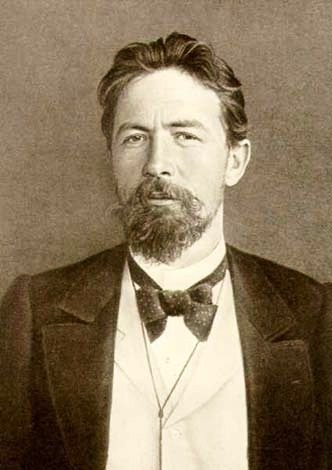
Some popular starting points for short story readers include, . Due to it's length I have classified it here as a book. It's also well known under the alternative title A Boring Story which is the title listed in the short story section as a convenience to readers searching under that name. Anton Chekhov himself was personally fond of his short story The Student.
In 1897 Chekhov was diagnosed with tuberculosis. He purchased land in Yalta in 1898 after his father's death and had a villa built. He moved into the villa in 1899 with his mother and sister. This was a very prolific period for the great writer and he produced some of his most famous work during this period.
Amongst those works is a trilogy featuring Ivan Ivanovitch, a veterinary surgeon and his schoolmaster friend, Burkin. The two are on a small trekking and shooting holiday. Chekhov overlays three stories that are amongst his most famous short stories in a trilogy sometimes referred to as "The Little Trilogy". The three short stories, in order, are:
It was also during this period in Yalta that he produced Three Sisters and The Cherry Orchard.
Witty to the end, Chekhov's last words were, "I haven't had champagne for a long time." His words were a play on a specific etiquette practiced in German medicine at the time; when it was determined that there was no hope for a patient's recovery, it was customary for the doctor to offer the patient a glass of champagne.
We feature two volumes of Anton Chekhov's great short stories in our Favorite Short Stories Collection
2.A Rose for Emily 獻給愛米麗的一朵玫瑰花"

A Rose For Emily" was American author William Faulkner's first short story to be published in a national magazine ( It was next published in a collection in 1931 and went on to become one of the most anthologized American short stories. By the way, if you run across a copy of These 13, you might be able to get big bucks for it on eBay.Faulkner had mixed feeling about the short story as form for his fiction. On the one hand, Faulkner refers to his short story work as "whoring." But, he also said this:Yes sir.
You can be more careless, you can put more trash in [a novel] and be excused for it. In a short story that's next to the poem, almost every word has got to be almost exactly right. In the novel you can be careless but in the short story you can't. I mean by that the good short stories like Chekhov wrote. That's why I rate that second – it's because it demands a nearer absolute exactitude. You have less room to be slovenly and careless. There's less room in it for trash
Well, there's no trash in "A Rose for Emily," with its intricate plot and crafty pacing. One thing we love about this little masterpiece of horror is its openness and flexibility. The possibilities for interpretation are endless, and it inspires very creative interpretations, in large part because of its unconventional style. This story has something for just about everyone. Anton Pavlovich Chekhov (Jan 29, 1860 - Jul 15, 1904) was a Russian physician and supreme short story writer and playwright. He was the third of six children.
His father was a grocer, painter and religious fanatic with a mercurial temperament who "thrashed" his children and was likely emotionally abusive to his wife. Chekhov, like Dickens, was no stranger to financial hardship and in 1875 his father took the family and fled to Moscow to escape creditors. Chekhov stayed behind for three more years to finish school. He paid for his tuition by catching and selling goldfinches and dispensing private tutoring lessons, and selling short sketches to the newspaper. He sent any money he could spare money to his family in Moscow. A child-family separation theme plays out in several of Chekhov stories including Vanka, The Steppe, and Sleepy
What William Faulkner did... and why you should careWar. I
ncest. Racism. Necrophilia. Mental illness. Suicide. In his collection of books, short stories, and poems, William Faulkner tackled nearly every aspect of life—from the mundane to the sensational—in the American South.
One of the most highly regarded novelists of the twentieth century, Faulkner was a brilliant, innovative, and notably eccentric man with a taste for whiskey (Faulkner began to drink heavily at the age of seventeen) and fragmented narratives. Throughout his life, Faulkner was something of a misfit, notorious for his haughtiness and his tendency to invent stories about himself.
In his writing career, however, Faulkner's unorthodoxy led to great success:
by pioneering new techniques in form and style, Faulkner helped revolutionize the notion of the "narrative" and, in the process, produced some of the greatest works of American literature. His story is all the more compelling considering that he never even graduated from high school! Although Faulkner received many awards and accolades
, he lived most of his life in obscurity; he was not regarded as an author of any real importance until he was nearly fifty years old. In addition, his personal life was a mess—he continually struggled with alcoholism, debt, and repeated bouts of infidelity. The story of William Faulkner's life is thus a tale of perseverance, failure, creativity, and success.
In his work, William Faulkner created some of the most enduring and detailed portraits of life in the American South. His novels, which explore family dynamics, race, gender, and social class, have riveted—and challenged—readers for over sixty years with their iconic characters, intricate plotlines, and myriad shifts in time.
Some of the greatest authors of the twentieth century, including Gabriel Garcia Marquez, Joyce Carol Oates, Albert Camus, Jose Luis Borges, Toni Morrison, and Cormac McCarthy, cite Faulkner as a major influence on their work. If you've ever read a book that doesn't move from point A to point B but, instead, from point A to point Z to point T and back, you should keep reading. Faulkner is one of the guys who did it first.


沒有留言:
張貼留言